
Founders obsess over names and logos. The real legal leverage sits in the goods and services description — and it is often misaligned with how you actually make money.
You spent hours hunting for the perfect name and logo - sophisticated, edgy, original. You tested what your shade of blue would make your customers feel. You bought the domains and searched the USPTO to see if anyone else had claimed the mark. You asked ChatGPT whether the name was available. You asked another AI tool whether the logo looked distinctive. Maybe the AI even told you the mark should be registrable. Great. None of that answers the next question your lawyer asks.
“What are you actually selling?” Because your description of goods and services is what the USPTO cares about.
That is how trademark law is built. A trademark or service mark identifies and distinguishes particular goods or services and indicates their source. In other words, the legal right is attached to what the business is offering under the mark, not the emotional reaction the name or logo creates.
The statute itself makes this point: 15 U.S.C. § 1127 defines trademarks and service marks by what they do - identifying and distinguishing goods or services and indicating their source.
Everyone in the Room Is Describing a Different Company
Suddenly, everyone in the room is describing a different company. Your marketing guru describes the promise. Product describes what ships today. Sales describes what customers want. You describe what you will look like when you ring the bell.
Meanwhile, your lawyer is trying to turn four different companies into one legal description for a trademark (a/k/a "mark") your business can actually stand behind.
Why? Because trademark law ties legal protection to what the business actually offers, not what the brand aspires to evoke. The mark protects the goods and services for which it is used. If the description does not match reality, the protection does not either.
The Mark Gets the Energy. The Description Gets Ignored.
We get it. There is a reason the mark gets all the attention. A name feels personal. A logo feels like identity. It is the part of the brand people can react to immediately, even when they do not fully understand the business yet. That part feels alive.
Trademark classes do not feel that way. Descriptions of goods and services do not get pinned to mood boards. Nobody starts a company because they are excited to decide whether the business is providing downloadable software, software-as-a-service, consulting services, educational content, marketplace services, or data analytics.
So many companies treat the description like an afterthought. It looks like a form. It sounds like something Legal handles after the real decisions are made. "Just file it," you tell your lawyer. Or worse, you file it yourself using the same ChatGPT prompt that helped you pick the name.
That afterthought is often where the biggest business question hides.
Your Description Defines What You Actually Protect
The mark says, "See me as this.” But the description tells the trademark office, future investors, potential buyers, competitors, and sometimes a court what the company actually does. Those are not the same thing.
The description also performs a public-notice function. Federal registration serves notice and search functions for everyone in the market - a point the Federal Circuit emphasized in In re Int'l Flavors & Fragrances Inc., 183 F.3d 1361 (Fed. Cir. 1999). A registration is not just a private asset for your company; it is part of a searchable legal record that competitors, investors, buyers, and future users are expected to evaluate.
Trademark registration is not simply a government blessing of a brand name. It helps create a public record that others can search when deciding whether a proposed mark creates conflict risk - the same search you relied on when you first looked up whether the name was already taken. Trademark law has a specific requirement: the mark has to be used in genuine commerce, real transactions, real customers.
"We plan to offer this" does not count unless it is an Intent to Use application.
An intent-to-use filing can preserve a path for a future launch, but it is not a license to describe every possible version of the company. You still must genuinely intend to use the mark in commerce for the goods or services you list (a "bona fide intention"), and the registration will not actually issue until you later file a sworn statement confirming you have started using the mark for the goods or services that remain in the application.
Imagine a SaaS founder who registers a mark for "software as a service featuring workflow management tools." At the time of filing, most of the company's revenue comes from implementation support, custom onboarding, and human-delivered configuration, not the software itself. The registration proceeds without issue.
Three years later, a strategic acquirer enters diligence. The buyer's IP counsel compares the trademark description against the revenue breakdown: the filing says SaaS, but the financials say services. The acquirer does not walk away, but it adjusts the purchase price and conditions closing on a supplemental services-class registration that should have been filed years earlier. The filing did not create the misalignment. It just made it impossible to ignore.
Or worse, you filed only for "business consulting" because that was how you started. Three years later, you've built a successful SaaS platform that generates almost all of your revenue.
That can sound technical. It is really a question about your commercial identity: are you a software company or a services company? A tool, a workflow, a marketplace, an advisory firm? The answer shapes the description - and the description shapes the protection.
Either way, the question does not go away. It just gets more expensive to answer.
A beautiful mark wrapped around the wrong business is A weak asset.
A trademark application is not asking for the most inspiring version of your company. It is asking what your business actually offers under that name today. And then you have to update it as you change. It is how businesses and trademarks evolve.
Brand drift can become legal drift. If the market stops associating your name with a specific thing you offer, the mark can lose its legal strength. Trademark protection rewards clarity. The more the market, and the legal record, understands exactly what your brand stands for, the stronger the protection.
When the Specimen Doesn't Match the Story
Another version of the same problem shows up when you are required to prove use of your mark in a way that matches your description. Suppose you describe your business as Software-as-a-Service featuring workflow management software - but your specimen shows consulting, implementation, and human support services. Now the examiner may start asking whether the specimen actually supports the application.
That is not a technicality. In an intent-to-use application, the post-allowance statement of use must include specimens showing use of the mark in commerce for the goods or services being claimed, and the trademark office may reexamine whether the mark, as used, is entitled to registration.
15 U.S.C. § 1051(d) requires a verified statement of use with specimens and provides that examination may include registrability factors under 15 U.S.C. § 1052. In Eastman Kodak Co. v. Bell & Howell Document Management Products Co., 994 F.2d 1569 (Fed. Cir. 1993), the Federal Circuit recognized that some registrability issues may not be evident until specimens showing the mark as used are submitted.
Your company may not have aligned its brand story, product reality, sales motion, and roadmap. The application did not create that gap - but it forces you to confront it.
Discipline Doesn't End at Registration
Once your mark is registered, using the ® symbol is not just a formality - it is legally meaningful. If you fail to use it and someone infringes your mark, you may not be able to recover money damages unless you can prove the infringer already knew about your registration.
"Most founders do not realize the ® symbol affects what they can collect in damages. Their lawyers sometimes forget to tell them."
Your Lawyer Should Know Your Business, Not Just Your Mark
A good trademark lawyer is not simply waiting for the business to hand over a name and a class number, and is not simply filling out forms. A good trademark lawyer is close enough to the business to help it decide what to claim, when to claim it, what should wait, and how the registration should evolve as the business evolves.
That distinction - between the company as filed and the company as it is actually growing, is precisely what the right legal relationship is built to catch.
Why? Because weak trademark filings do not cause immediate pain. The application gets filed. Your brand launches. You move on. Nobody holds a meeting six months later to say, “We protected the wrong version of ourselves.”
The consequences usually arrive later, wearing someone else’s calendar invite. A competitor appears in a nearby category. A new product line launches faster than expected. You expand into a service area that the original filing barely covers.
An investor asks for the IP schedule. A buyer’s diligence team wants to understand whether your brand protection matches the business being acquired. A dispute reveals that your registration tells a narrower, vaguer, or different story than everyone assumed.
By then, the issue feels annoying because it seems like old paperwork. But old paperwork has a way of becoming current when money, control, or credibility is involved.
That is exactly why the scope of the filing matters. In Levi Strauss & Co. v. Abercrombie & Fitch Trading Co., 719 F.3d 1367 (Fed. Cir. 2013), Levi Strauss challenged Abercrombie’s stitching-design registrations even after related district-court litigation over Abercrombie’s actual Ruehl-line products had ended. The Federal Circuit held that the PTO challenges were not precluded because the registrations covered a broader range of uses than the specific product use litigated in court. The lesson for founders is practical: the registration is not just a snapshot of one product launch; it can define a broader legal battleground later.
Federal registration gives you a legal head start in a dispute, but only for the mark and the goods or services actually specified in the certificate. That is why a registration that accurately tracks the business can be an asset, and one that tracks the wrong business can become a diligence problem.
15 U.S.C. § 1057(b) provides that a registration on the Principal Register (the USPTO's main trademark register) is prima facie evidence - meaning it is accepted as proof unless someone disproves it - of the validity of the mark, your ownership of it, and your exclusive right to use it in commerce for the goods or services specified in the certificate.
Brand protection depends on understanding how the company sells, how the product is changing, where leadership is taking the business, and what story the company will need to defend later. A trademark lawyer who sits outside the business and waits for filing instructions cannot do that work well. Legal is not a department that appears at the end of the naming process. It should be close enough to the business to know when the company’s market-facing story has moved beyond its legal protection.
The best trademark process is not a handoff from Marketing to Legal. It is a recurring conversation among Legal, Product, Sales, Finance, and leadership about what the company is actually selling and what enterprise value the brand is expected to protect.
What to Do Before You File
Before your lawyer submits anything, work through these steps:
Map today vs. tomorrow. List what you actually sell today, what launches in the next six to twelve months, and what is still speculative. Your filing should reflect the first column. Your lawyer should know about all three.
Align the room. Ask Marketing, Product, Sales, and Finance to each describe the business in one sentence — then reconcile the differences. If the sentences do not match, your trademark description will not either.
Sanity-check your specimen. The website screenshots, product pages, or sales materials you plan to submit must show the specific goods or services you are claiming. If what you have ready does not match what you are filing, that is a problem to solve before filing, not after.
Review your real revenue drivers. Make sure the description covers how the business actually makes money today, not just the version that looks best in a pitch. A filing built around aspirational revenue is a filing built on thin ground.
Schedule a brand check-in. Trademark protection is not a one-time event. Build a recurring review into your legal calendar for any time your product category shifts, your go-to-market changes, or you start describing the company differently to investors or acquirers.
If your team cannot agree on the answers before you file, that disagreement is worth resolving. Your trademark lawyer can help surface the right questions, but the answers have to come from inside the business.
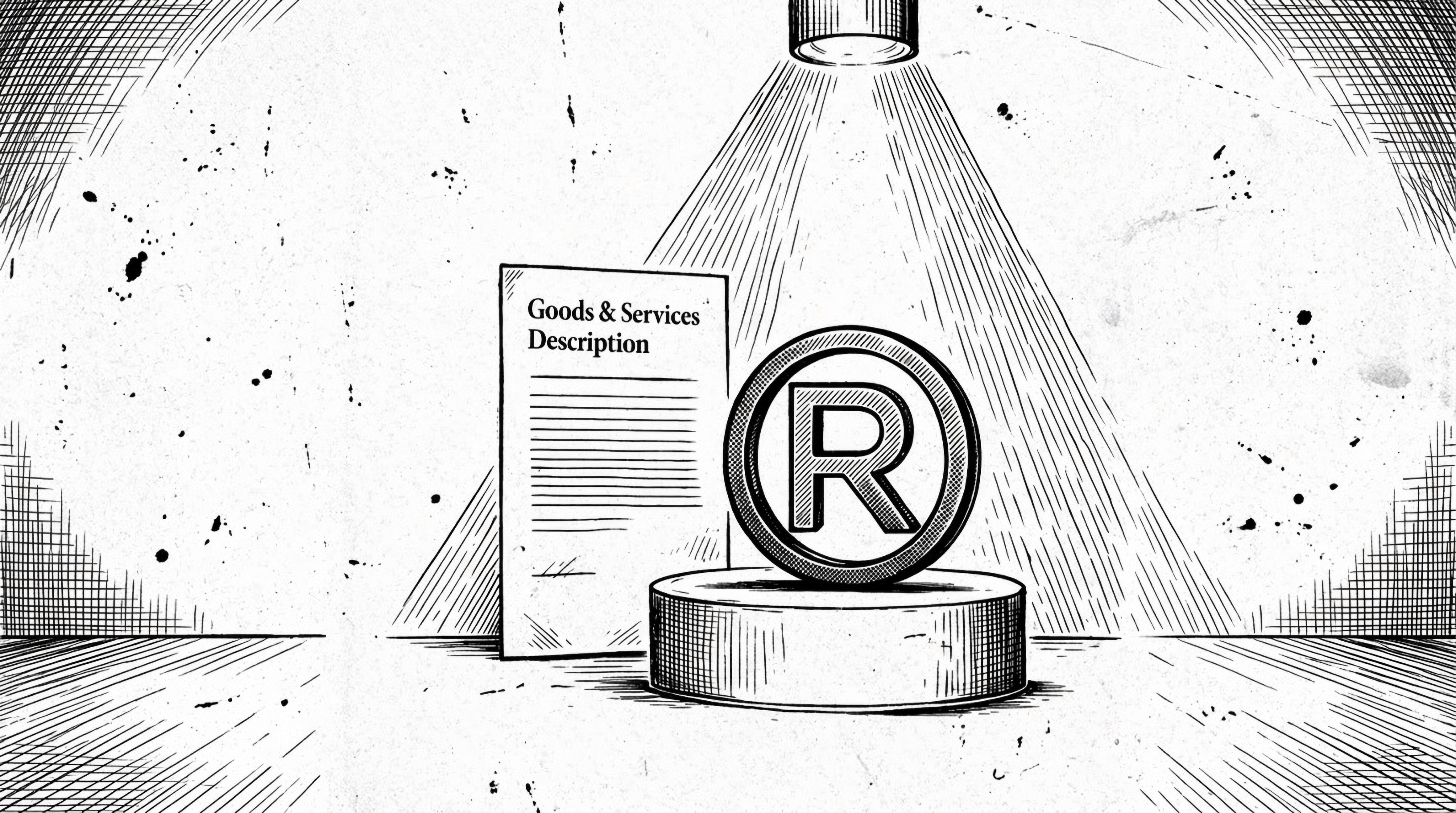
The mark may be the most visible part of the filing, but the goods and services description is often the most important.
Because that description affects not only whether the application gets approved, but what protection you actually have when someone else enters your market. And a trademark filing is not simply a branding exercise.
It is one of the first places where a company has to decide, in legally meaningful terms, what business it is really in.
Before you file, or if you filed a while ago and your business has moved on, it is worth a fresh look at whether your trademark actually protects the company you run today. Let’s talk through what you’re really selling and make sure your filing reflects it. Reach out to schedule a brand and trademark check-in.
We'd love to help!